 Although Susan Pearce, now Professor Emerita of Museum Studies at the University of Leicester (UK), wrote this influential book over twenty years ago, it continues to provide valuable insights for those who want to better understand our fascination of cultural representation through the collections of things.
This book was initially intended for those in curatorial practice who also believe in the crucial role of theory and the inseparability of them both. It aims to analyse the many ways in which meaning is created within museums and to 'recognise the unique significance of museums and collections in the European cultural tradition' - i.e. the formation of the modern world roughly between 1450 and 1950. It also suggests alternative directions to consider with the challenges that the Post-Modern era of subjectivity has brought with it.
This critical tradition, regarding the critical study of museums, is however relatively new (1970's+). Beforehand, most criticism was generally confined to each academic subject category with little socio-cultural analysis of the practice of displaying collections in purpose built buildings (museums).
In western culture thoughts on materiality can be traced right back to Plato, and since then collectors and museums have generally served to reinforce this ideology, with their focus being primarily on the appreciation of physical things for the purpose of understanding. In more recent times, this logic has also spread to traditionally less materialistic cultures, such as China, India and Africa.
The term Matter is derived from the female; Mater (p19). Mutter becomes Meter – or the dividing up (measurement) of the divine (male God). The inference being that things, from a western ideological perspective, are less important than spiritual illumination/resurrection and therefore materiality is seen as something to order, control, or even curb. As a result, constructing meaning (representation) or getting to the 'heart of the matter' is one-thing collections appear to have been continually trying to do to narrow the gap. Also interesting is the notion that as objects/collections are seen as specific signifiers, they in turn come to 'have a life of their own' and so give power to and have power over the collector. Objects therefore have the potential to act as a bridge between both this world and ‘other’ worlds when imbued with meaning and hyper-significance. For example souvenirs act as individual ‘bittersweet longings for a past which is seen as better and fuller than the difficult present’ (p72). Are then collections primarily assemblages of subjectively chosen (& then organized) souvenirs? Reminders to the collector themselves of who they have chosen to become?
The book offers an insightful range of reasons and methodologies through which people have attempted to understand objects and collections within museums. The ultimate aim is usually to better understand ourselves through representations of our histories. However, as stated in the summary of Meaning in History, Pearce acknowledges that "For the past is essentially unknowable, forever lost to us, and in museum displays its material traces are reconstructed into images of time past which have meaning only for the present, in which their genuinely intrinsic relationships to the past are used to authenticate a present purpose.' (p209)
Perhaps this desire to authenticate the present through a representation of the past reveals the inevitability of never really knowing or understanding ourselves, but is what perpetually drives us to try anyway. In part then by visiting museums we are driven by the futility of trying to come to terms with our inner confusions and wonders of our own existence, our relationships with others and ultimately our place in this world. Or as Pearce puts it 'Objects are therefore actors in the story, not just the reflection of action, and themselves have a role in creating that change which we call the process of history.' (p211). Or 'the object is inexhaustible, but it is this inexhaustibility which forces the viewer to his decisions. The viewing process is selective, and the potential object is richer than any of its realisations... In one sense it is relating the developing personality of the viewer and so acting as a kind of mirror; but at the same time the effect of the object is to modify or change the viewer, so that he is a slightly different person from the one he was before.' (p219).
Or putting it more concisely, objects can be seen primarily as ‘facilitators of ideas between people,’ (Powell 1997) and as such are laden with both objective and subjective (polysemantic) meanings and intentions. It is this that makes things so interesting and our relentless desire to see new 'curiosities' so rewarding. Museums being the custodians of officially recognized collections, curated by officially recognized professionals, have therefore become the ideal final destination for objects of 'worth'... a safe haven where (western) cultural ideas and values are preserved and endlessly re-presented to future generations in search of understanding.
Finally Pearce suggests that curators, even more than ever, need to consider new ways to convey meaning through their work, even when faced with the subjective nihilism of the poststructuralist/postmodern era we now find ourselves living in. A potential 'future' direction of utilizing museum collections to stimulate critical argument (remember this book was originally published in 1992) is something we should not forget in our modern fast paced world of endless distractions and Facebook likes.
Looking back with hindsight it can be seen that some ideas encouraging more subjective reflection have since occurred within the museum sector, and with some notable successes (consider newer practices of wider visitor engagement and involvement). Or as Pearce suggests 'Metaphorical activity offers a capacity for reinterpretation amongst ideas which have become objective property' (p263). Of course in 1992 we were only just hearing about radical new opportunities possible through the opening up of the World Wide Web. Alternative methods of sharing and communicating collections, along with alternative viewpoints, ideas and meaning (e.g. Obsessionistas) were still yet to be conceived. Also now possible is a return to the original intentions of the collectors themselves, along with their own subjective explanations as to how and why they put their collections together. Twenty years on then we do have a refreshing alternative/antidote to the objective sense making of generations of official cultural commentators, professionals and institutions.
Pearce, S. M. (1993) Museums, Objects and Collections. Smithsonian Institution Press
reviewed by Graham Powell of Obsessionistas

 Sunday, September 2, 2012
 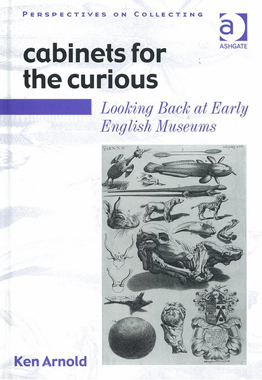 From a series of books titled Perspectives on Collecting by Ashgate; ‘Cabinets for the Curios’ reminds the reader of the practices and traditions that our museums evolved from. Over the centuries, narrative and functionality often lost out to the obsession with categorisation and ordering of collections. Another interesting insight is that the recent ‘de-intellectualisation’ of many British museums, through the intensive reliance on base level electronic interactions, might benefit from a review. Traditionally exhibitions were curated to encourage voyeuristic and reflective observation of historical artefacts – something to be reinstated. Indeed a lesson from the past itself would do no harm either, particularly from the successes of the original ‘cabinets of curiosities’ of the seventeenth century.