









iPods #0119

The collector: Nick Jarman, Berkshire, UK
The collection: Apple iPods
The story behind the collection...
What do you collect? iPods. More precisely, anything that's branded as an iPod. I don't collect iPhones or iPads, even though elements of their functionality are the same.
How long have you been collecting them and how many do you have? It's hard to say exactly when I started collecting. I bought my first iPod (an iPod mini) in 2004. My wife bought one at the same time, but replaced it with an iPod nano the following year. Each year after that, Apple launched a new iPod nano and my wife bought one. We never sold the old ones, so at some point, I must have started 'collecting' her cast-offs! I now have over 30 iPods, an example of almost every model, from the original to the newest.
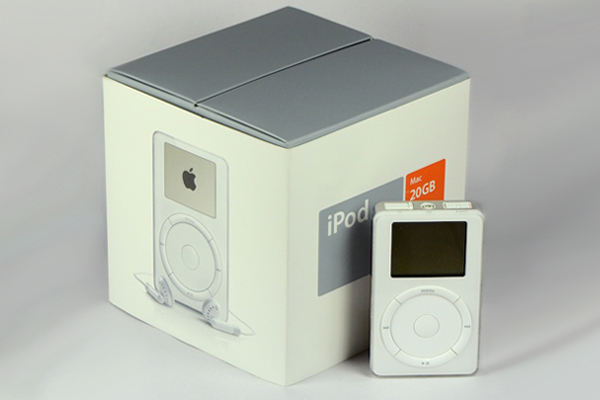
1st, 2nd & 3rd generation iPods
How do you define the limits of your collection (date, type etc)? Any iPod, from the earliest to the latest. I don’t feel the need to have an example of each different capacity, but it might be nice to have an example of every colour though!
Why no other MP3 players, are you a general Apple fan or is it just iPods? Yes, I’m an Apple fan, so focusing on iPods makes sense. This makes it possible to have a relatively complete collection without amassing too many items. I think 30 pieces is quite a small collection by most standards!
What is it you particularly like about them (e.g. design, social history, audio quality, iTunes integration… or)? iPod audio quality is not the best, but it’s certainly good enough, especially when you realise that most listening is done in less than ideal conditions. The ‘good enough’ audio quality, combined with the ease of filling it with music from iTunes, and the simplicity of the iPod’s controls seems like the best set of compromises of any MP3 player design. It’s simply a well thought out product, supported by a good service (iTunes), just as it was in 2001.
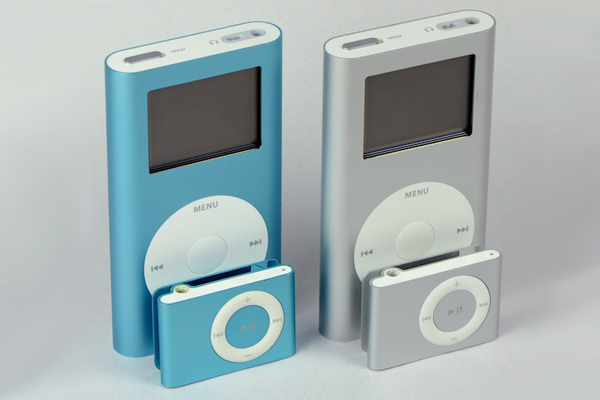 1st generation iPod Minis and Shuffles
Are Apple iPods the natural successors to the Sony Walkman? Yes - neither the Discman, nor Sony’s later MiniDisc players were ever synonymous with portable music in the way the Walkman was and the iPod is now. On that basis the iPod is a worthy successor to the Walkman.
What do you think the hardware’s design communicates? Simplicity and consistency. More recently: quality. The early iPods were better than the competition because the design made it obvious how easy they would be to use. Each iPod had a family resemblance to the others in the range, so it was easy to differentiate an iPod from any other brand of MP3 player. As time has gone by, Apple has used better materials, better finishes and tighter tolerances in its manufacturing, setting their products apart from the competition. You only have to turn an iPod over in your hands to see how well all the parts fit together and notice the absence of gaps and poor fitting, creaky plastic panels. However, while the design communicates quality, it does not do so in the sense of a luxury or premium brand. There is no ‘premium’ iPod, there is no ‘premium’ MP3 player of any other kind. With the iPod, Apple makes the best portable music player available to everyone, surely the sign of a great design.
Is the product or the concept a ‘design classic’ (if at all)? The ‘wheel-and-screen’ iPods are certainly design classics. They’re distinctive and unmistakable.
What are your opinions over the often-muted comparison of the early iPod to the 1958 Braun T3 radio designed by Dieter Rams? Superficially, there’s a striking similarity between the two products. The T3 is frequently shown next to an iPod, with its dial at the bottom and the speaker at the top. However, this is not the orientation the radio was designed to be used in. Looking at the back of the radio, where the Braun logo and the MW/LW switch are found, you can see that the dial is actually on the right and the speaker is on the left. Scale is another factor ignored during comparison: side-by-side comparison photos usually make the iPod and the T3 appear roughly the same size. In fact, the T3 is actually substantially larger - at least half as large again in each dimension. Its cabinet volume is about 4 times that of the largest iPod.
So the two products are not nearly as similar as some might suggest. Having said that, it’s a well documented fact that Apple’s design team is inspired by Braun. Were they inspired by Braun products when designing the iPod? Almost certainly. Did they set out to make the iPod look like a T3? Almost certainly not. The only example I know of them directly copying Braun is in the design of the calculator app for the original iPhone and iPod touch, where the keypad was identical to an ET44/ET66 calculator. Unfortunately this was removed from the next version, but I think it’s a shame that Apple didn’t license the design from Braun. A better example of direct copying can be found in the iPod’s wheel. The first iPod had a rotating wheel with a central button. This was used to scroll through lists and make selections. It is identical in functionality, feel and weighting to the wheel found on Bang & Olufsen’s BeoCom 6000 phone. The BeoCom 6000 was release in 1999, two years before the iPod and it is said that Bang & Olufsen wish they had patented the idea so they could capitalise on its use in the iPod.
7 x iPod shuffles
Is Apple’s current minimalist aesthetic ‘chromophobic’ (white, black and/or silver) …except for the few iPod exceptions? Currently, yes. Though I think it’s a shame that they no longer offer colourful computers like the original iMac. Surely there’s a market for a MacBook Air with a coloured anodised alumnium enclosure. However, that market is probably too small to be worth addressing. It seems to be the case that the bolder the colour scheme, the smaller the object it can be successfully applied to. If this is true, the iPod will remain the only colourful item in Apple’s range until tastes change.
Where do you think the iPod is heading next? e.g. further integration into other Apple products or will it continue to be a distinctive individual unit in it’s own right? For the next few years, it’s clear that the iPod will continue as a product in its own right. However, sales have been declining for a number of years, as its functionality is subsumed into the iPhone (consumer demand is for a combined phone and MP3 player rather than separate units). I expect the iPod classic will be the first to be discontinued. This will happen when the capacity of the iPod touch is close enough to the classic’s 160GB that there won’t be an outcry from the people who want to put their entire music collection on their iPod. After that, I expect there will be some consolidation of the smaller players (nano and shuffle), but that won’t be soon.
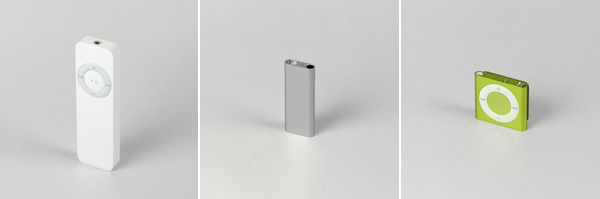 1st, 3rd & 4th generation iPod shuffles
Do you have a favourite… is there a quintessential iPod overall? My favourite is the 3rd generation iPod. This model had some unique features - for example, illuminated controls and no moving parts on the front panel. It was entirely touch sensitive, years before the iPod touch was announced. It stores three times as many songs as the original iPod, yet it is three quarters the thickness. It’s the first iPod with the soon to be obsolete, yet hugely ubiquitous dock connector. In some ways, it showed what the future of the iPod would be, whilst in other ways it was a dead end. As for the quintessential iPod - that’s the one you own and have used the longest - quintessence is personal.
Do you use them, if so which ones, when (and why those)? I use them less than I used to, because my iPhone tends to have all the music I want to listen to. However, I try to use at least one different iPod per week, even if its only for a short time.
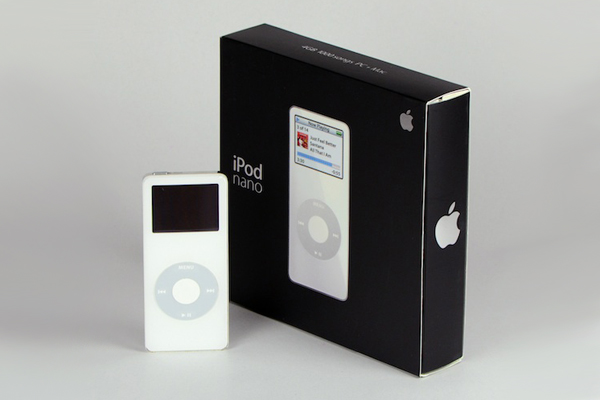 1st generation iPod nano
Is there anything still missing from your current collection or is there a particular iPod that you don’t yet have that you would really love? There are a few gaps, but the most obvious omission is a U2 edition. These are distinguished by their black case and red wheel, however, it is difficult to find one in good condition.
Are there any issues with maintaining older machines with old or updated software? Software is not generally an issue, currently all iPods are supported by the latest version of iTunes (10.7). The main problem is battery degradation, which gets worse if the battery is kept in a discharged state for a long time. Keeping 30 iPods charged as part of a normal routine is basically impossible, so there is a risk that some will become damaged through lack of use and subsequent charging.
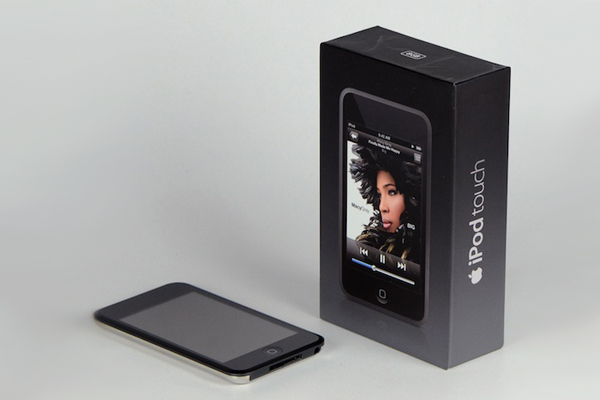 iPod touch 1st generation
How is your collection is stored, arranged or displayed. Is it kept in a special place or displayed in a particular way? The whole collection is small enough to fit into a shoebox. However, I also have the original packaging, which takes up significantly more space! The iPods are not currently on display, but I would like to find a way of showing them which does not risk discolouration or other light-related damage.
Would you like to share any recommendations with Obsessionistas readers? I haven’t found any websites dedicated solely to iPod collecting or iPod history. The internet seems mostly devoid of any comprehensive, objective iPod resources. However, for raw data, www.everyipod.com is quite useful. Buying is difficult, eBay is the obvious place, but prices are high and so are the risks and quality is generally low.
All images © Nick Jarman and used with his kind permission.
 Sunday, September 23, 2012
Reader Comments