


















DESIGN ARCHIVE: BROOKS ENGLAND

 Design Archive: Brooks England
Est. 1866
Location: Smethwick, West Midlands (UK)
JB Brooks & Co became known and respected for their beautiful leather handcrafted saddles using traditional techniques passed down from generation to generation of craftsmen, as the company grew under the guidance of the Brooks family until 1958. In more recent years they have struck out as Brooks England and continue to honour the company's heritage. Inspired by the timeless products designed by their predecessors, they have revived the original slogan 'Saddles, Bags, Etc.' and introduced an exciting range of cycle bags and other cycling accessories. Their design archive collection spans the company's history from the birth of the cycle industry until the present day.
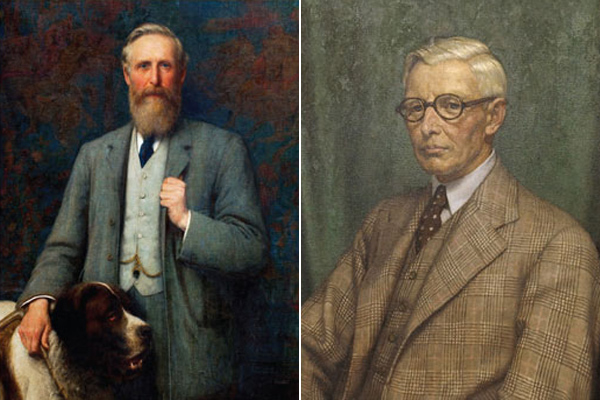 Established by John Boultbee Brooks in 1866 the company grew under the guidance of the Brooks family until 1958
Legend has it that in 1865 a young man of 19 years called John Boultbee Brooks bought himself "one of those new fangled velocipedes". He would have cut quite a dashing figure back in the day, but that was not all he cut; the wooden saddle was excruciatingly uncomfortable. So Brooks, whose father made leather saddles for horses, set about designing and developing a comfortable saddle from leather in his father's works.
In 1866 he established a works in Great Charles Street, Birmingham for the manufacture of leather strapping for horse harnesses and general leather goods. Just a few years later in 1870, noting that more and more people were indulging in the new pastime of cycling, John Boultbee Brooks began to seriously manufacture bicycle saddles.
 First saddle patent 1882
The first safety bicycle came on the scene in 1880 and with it the need for more comfortable saddles. No longer were riders willing to accept that the only option open to them was to ride on a piece of formed wood. Brooks filed his first patent for a sprung bicycle saddle, the first of its kind, in 1882. After that he went on to file a number of patents for bicycle saddles, motor cycle saddles and other leather goods. These included galoshes, snap-on leggings, handlebar muffs, folding footrests, toe-straps, gents and ladies cycling shoes, oil-skin clothing and, of course, bags.
1898 catalogue
Many of these items are still in existence now and can be found in cycling museums in both Wales and Cornwall. A little known fact however is that Brooks also manufactured furniture - chairs, tables, desks, cabinets and mirrors for home, hotel or business use and stools, lockers, cupboards, bins, shelves and tables for commercial and industrial usage. Many of them are chronicled in a collection of catalogues held in the Brooks archive.
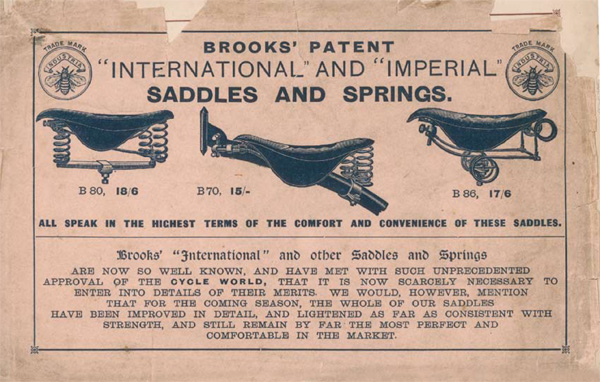 A catalogue from 1890
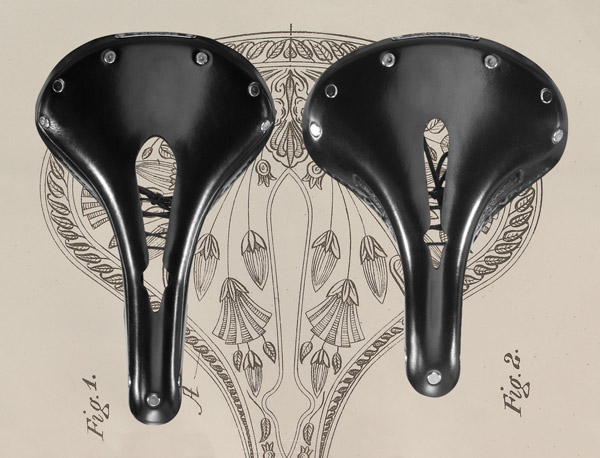
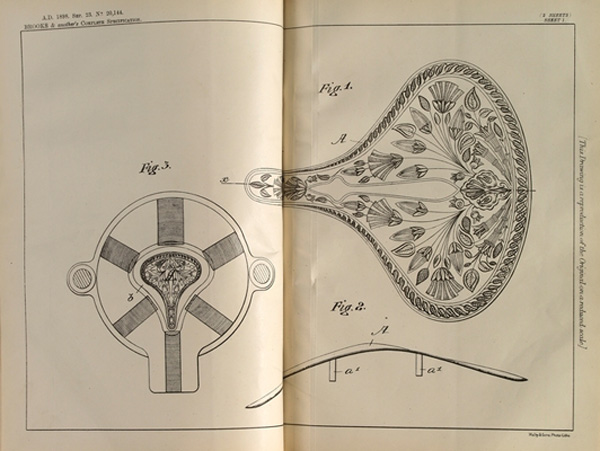 Patent from 1898
By the early 1900s Brooks Ltd. was offering an astonishingly broad range of bicycle saddles and other accessories such as saddle bags, tool bags, saddle back rests, inner tube cases, motorcycle belt cases, pannier bags, luggage bags, hat cases and even bicycle mounted cigar trays.
In the 1920 Brooks took over the Lycett Saddle Company and Brooks saddles became the first choice of cycling champions. During this period each and every rider in the Tours utilized a Brooks Saddle and one of Brooks current marketing campaigns revolves around photographs of famous yesteryear cyclists undertaking the stages of the Tour de France with Brooks Saddles.
In 1926 the B66, Brooks best-seller was introduced. This saddle still makes up over a third of the company's total saddle sales - despite what might be regarded as far more advanced designs having been introduced. A History of Industry in Birmingham; the centre of bicycle saddle manufacturing in Britain, mentions that in 1935 of the 2,733,000 cycle saddles manufactured in Britain, no fewer thatn 60 per cent were manufactured by J.B. Brooks & Company.
1934 catalogue
At the outbreak of the second world war Brooks' skills and plant were rapidly harnessed to help the war effort, but following the end of the war Brooks entered a period of expansion unlike anything it had ever experienced before and the 1950s were a boom time for Brooks. With a workforce of 1,500 they were selling some 55,000 leather saddles and 25,000 mattress saddles a week.

In 1958 the saddle division of Brooks Industries Limited, as it was now called was taken over by the Raleigh Cycle Company and in 1960 Raleigh was bought by British Tube Investments Group, which then transferred Brooks and Sturmey-Archer first to its automotive and then to its bicycle division. Brooks then moved to the Downing Street Works in Smethwick, Birmingham, to be combined with the Wright Saddle Company, to form the Raleigh Saddle Division. The current Brooks facility can be found five kilometres northwest of the original site in the town of Smethwick.

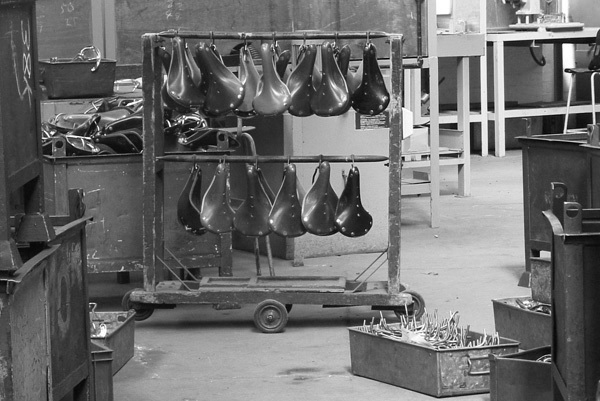 In July 1969 the Brooks facility was ravaged by fire and gutted. Undaunted, Brooks staff salvaged what was left of the plant and stock and continued production.
 In 1987 Brooks, as part of the T.I. Bicycle Divsion was then taken over by the American Derby International Group and in 2002 Brooks England were taken over by saddle giants Selle Royal, who manufacture 80,000 saddles per day (more or less what Brooks produce in a year) concentrating on PU foam and gel technologies. Despite such advances in technology Selle Royal has contined to keep the brand alive, with respect to its tradition and history.
 Today Brooks exports to over 20 countries and a special range has even been re-developed for Japan, where it is held in high repute as the connoisseur's choice. In Scandinavia there is a resurgence for Brooks, which had disappeared for over 2 decades. Germany continues to be Brooks largest customer by quantity and The Netherlands by head capita.
As such, Brooks saddles are prospering in a competitive marketplace and continue to be proudly produced at their factory in Smethwick, Birmingham.

Obsessionistas would like to thank Bregan Koenigseker and Steve Green from Brooks England for kindly allowing us to reproduce images and extracts from their archive.
Visit the Brooks England website here.
All images © Brooks England and published with their with kind permission.